Dr Rabindra Narayan Behera: Putting Jajpur’s Development Priorities on the National Agenda

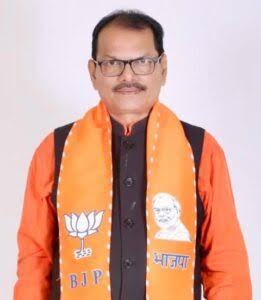
From parliamentary interventions on railway connectivity to planned urban development and support for traditional weavers, the BJP MP has raised a range of issues concerning his constituency.
Dr Rabindra Narayan Behera, the Bharatiya Janata Party (BJP) Member of Parliament from Jajpur, has focused his parliamentary interventions on connectivity, industrial and urban development, traditional livelihoods and the district’s cultural heritage. Elected to the 18th Lok Sabha in June 2024, he represents the Scheduled Caste-reserved Jajpur constituency in Odisha. According to the official Parliament profile, he holds a PhD in Artificial Intelligence from Utkal University, Bhubaneswar, and became a member of the Parliamentary Standing Committee on Communications and Information Technology in September 2024.
Narrowing the development agenda
One of the major issues pursued by Behera is the proposed Jajpur Road–Dhamra railway link. The 101-km project has the potential to improve connectivity between industrial, commercial, religious and tourism destinations. In a Lok Sabha reply on February 11, 2026, the Railway Ministry said the survey had been completed and the Detailed Project Report prepared, while further consultations and approvals were required.
A significant subsequent development came on October 12, 2026, when the Public-Private Partnership Appraisal Committee granted approval for the proposed 101.26-km Jajpur-Keonjhar Road–Aradi–Dhamra Port railway line. The project, estimated to cost ₹2,763 crore, is planned under the public-private partnership model and includes 10 intermediate stations. The next steps in the approval and implementation process will determine its progress towards construction.
Behera has also raised the need for integrated urban planning covering Kalinganagar, Vyasanagar, Jajpur Road and Panikoili. He brought the issue before the Lok Sabha on February 6, 2026, highlighting the need to plan these growing industrial and urban centres in a coordinated manner. The proposal reflects the challenges of managing infrastructure, transport and public services alongside industrial expansion.
Parliamentary record and local livelihoods
According to PRS Legislative Research, data covering June 24, 2024, to August 13, 2026, show that Behera recorded 89% attendance in Parliament, compared with a national average of 85%. During the period, he asked 19 questions and participated in 13 debates. His interventions included issues concerning tussar weavers, irrigation canals, tourism, industrial development and the proposed railway connection.
Traditional livelihoods have also featured in his parliamentary work. On December 12, 2025, he raised the concerns of Jajpur’s tussar weavers, while a parliamentary question on December 16, 2025, addressed capacity-building for tasar weavers. These issues are important for a district where traditional crafts and rural livelihoods coexist with industrial growth.
His parliamentary questions have also covered tourism development, the revival of Pushpagiri Vishwavidyalaya, fertilizer distribution in Jajpur and corporate social responsibility activities associated with mines in the district. The range of subjects indicates the breadth of issues being raised on behalf of the constituency, although the eventual impact will depend on government decisions, funding and implementation.
Industrial growth and coordination with the State government
Jajpur’s industrial development remains another important part of the constituency’s wider agenda. On October 15, 2026, Chief Minister Mohan Charan Majhi unveiled or launched 46 industrial projects across 14 districts, involving an estimated investment of ₹39,383 crore and projected to generate 42,512 jobs. The event was held at Kalinganagar in Jajpur district, with Behera among those present. These figures relate to the projects across the State, not exclusively to Jajpur.
Earlier, on August 24, 2026, Behera and Dharmasala MLA Himanshu Sekhar Sahoo met the Chief Minister at Lok Seva Bhawan to discuss development issues concerning Jajpur. The meeting reflected coordination between elected representatives and the State government on district-level priorities.
The road ahead
Behera’s tenure presents a broad development agenda involving railway connectivity, planned urbanisation, industrial growth, traditional livelihoods and cultural tourism. His educational background in artificial intelligence and membership of the Parliamentary Committee on Communications and Information Technology also provide a connection to discussions on technology and governance.
The key test will be how far parliamentary interventions translate into completed projects and measurable benefits for residents. For Jajpur, progress will depend on timely approvals, coordination between the Union and State governments, infrastructure investment and attention to the needs of rural communities, workers, artisans and young people seeking employment.
As the district balances industrial expansion with its agricultural, cultural and religious heritage, the implementation of these priorities will remain central to its development. For Dr Rabindra Narayan Behera, the challenge is to convert the issues raised in Parliament into practical outcomes that improve connectivity, create opportunities and strengthen public services across Jajpur.